Component 3 year 1

The Cult 


FIRST DRAFT – OCTOBER 10, 2019 


INT. INTERVIEW ROOM – DAY 

MID SHOT. The Brightly lit room is the focus of the scene. We can see the top half of a wooden chair. The walls are white but has a spotlight on the back of the wall. Hannah walks into the room and sits in the chair. She looks towards the audience, which shows that the audience point of view is a camera recording Hannah. She has long blonde wavy hair that goes below her chest. She has a scar on the right side of her face on her cheek, and dark bruised bags under her eye lids and she also has an emotionless face while she stares into the camera. 


HANNAH 

I didn’t think that I would make it. 


EXT. OUTSIDE CULT HOUSE – NIGHT 

MID SHOT. Hannah is walking towards a house, with a note in her hand that was sent to her. It reads “meet me at house number 8” 


INT. CULT HOUSE – NIGHT 

STATIC MID SHOT. Hannah enters the house and goes inside with a curious yet fearful look. The creaky door is loud and increases in volume as Hannah opens the door further. 

OTS MID SHOT. Hannah looks down the corridor of the house after she opens the door, we hear Hannah’s shaky breath as she inches closer into the horrific looking house. 

MID SHOT. Hannah looks at the mirror and sees the reflection of another room to her left. 

Hannah walks into the kitchen and finds a knife dug into a cutting board and takes it 

Hannah then hears a sound coming from the corridor, similar to heavy footsteps. She then runs to the cupboard looking room that she finds 


INT. THE CULT HOUSE – NIGHT 

CLOSE UP. The tight room is so dark that all we can see is Hannah’s eyes. There are tears in her eyes and she is holding her hand over her mouth to quiet her breath. There is creaking wooden planks from footsteps coming from outside the room that Hannah is in. 


CULT LEADER 

If you come out of hiding now Hannah I promise I won’t hurt you 


Once the sound of the cult leader’s footsteps and voice can’t be heard anymore Hannah opens the door of the room she’s locked in. There is a tracking shot of the back of Hannah walking through the creaky hallway. On every step she makes a creaking sound on the wooden plank floor. While she is walking she slowly turns towards the camera to check if anyone is behind her. We are then given a medium shot of the dark and dingy hallway with the colour pallets consisting of a dark pumpkin orange and mucky grey. There are blood stains all over the wall that are dried up and turning black. The house is riddled with mice and there is constant squeaking all around the house coming from the walls. Hannah is wearing a white shirt which has fresh blood stains all over the front of her. She is wearing a long black dress that is old and torn and black boots that go just above her ankle. Her blonde hair is messy and full of dirt and dust. Hannah has bruises coming from her wrist to her shoulder on her right arm. Hannah freezes in the middle of the hallway when she heard a thump from a different room. She starts to breathe heavily and begins to panic. Hannah sprints as fast as she can towards the door at the end of the corridor. 


HANNAH 

Shit. 


As Hannah says “Shit” she turns to the other side of the corridor as she hears footsteps coming from the other end. The camera turns into an over-the-shoulder shot with Hannah facing the Cult Leader from opposite sides of the hallway. He is over 6ft tall and wearing a checked shirt which is brown and grey. He has large trousers on with massive boots. He is wearing a constant smirk and his eyebrows are bushy and low on his face. In his right hand he is holding an axe which is being dragged across the floor as the cult leader walks towards Hannah. The camera changes to a closeup of Hannahs face where she looks panicked and begins to sweat. Hannah rips her dress out of the nail and runs towards to door to find that it is locked. We see a closeup of Hannahs hand and her rattling the handle and banging the door. 


HANNAH 

HELP ME!! SOMEBODY HELP ME PLEASE! 


The camera switches to a midshot of Hannah facing the camera with the locked door to her back. The camera slowly zooms into Hannah and we can hear the footsteps of the cult leader walking towards Hannah. We then see a closeup of Hannahs face, screaming silently in pain. At the same time we hear the sound of the axe going into Hannah’s stomach. The shot changes to a low angle shot of Hannahs face. Then the door opens but the shot turns black. 


INT. INTERVIEW ROOM – DAY 

MID SHOT. We see Hannah back in the interview room, now with blood seeping through her shirt from the axe wound in her stomach. The camera quickly switches to an extreme close up of the side of Hannahs mouth. She is trembling and crying. A teas falls off her face as she speaks. 


HANNAH 

And that’s the story of how I died. I told you that I didn’t think I was going to make it.  


The camera then goes black and very suddenly the title of the film comes up on the screen with an “insidious” style. At the same time as the title appearing there is a loud range of sounds playing at the same time from a range of instruments. The opening title is intended to jump scare the audience.  


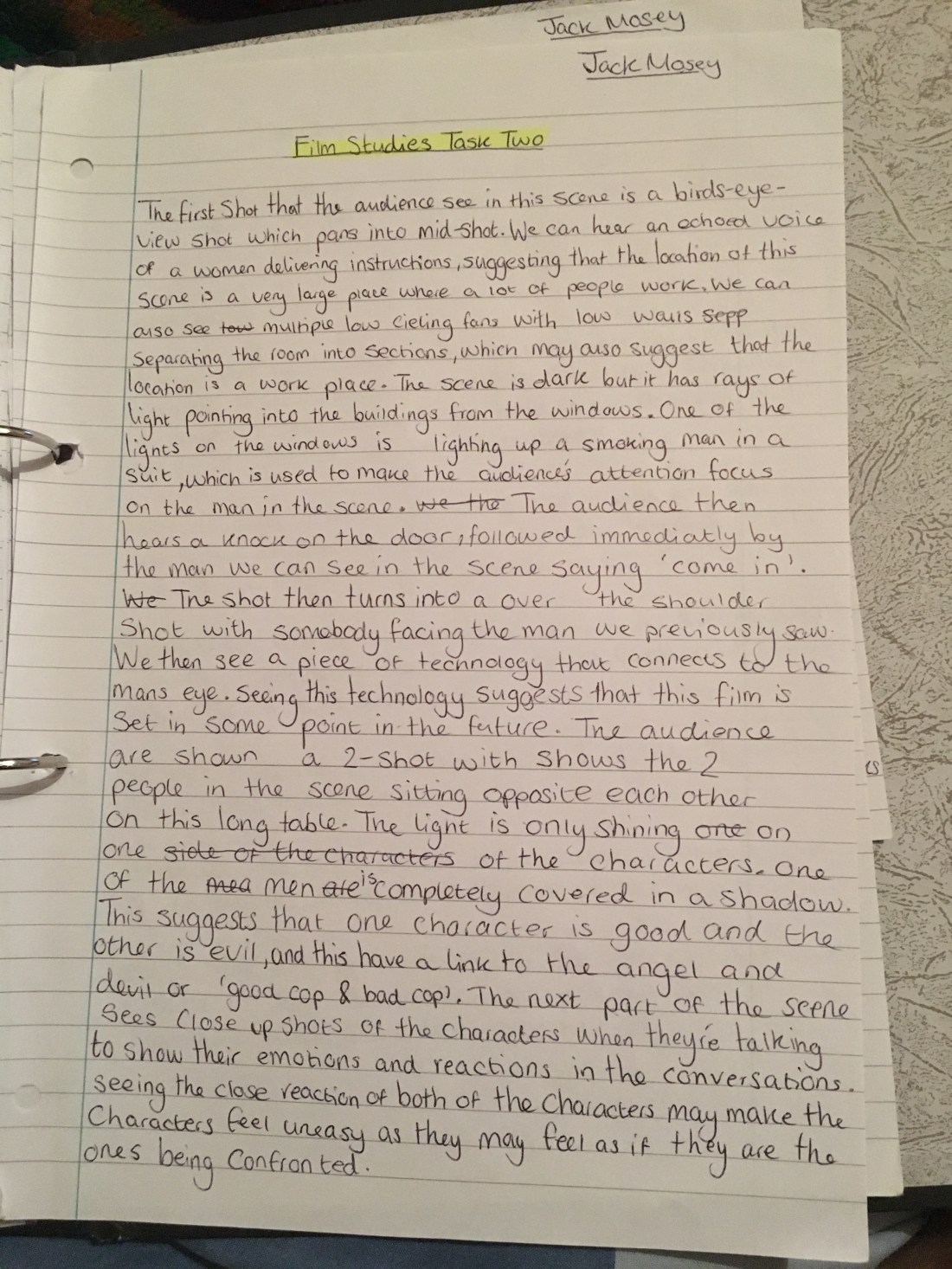
INT. WITCHES COVEN HOUSE. TRACKING SHOT. The camera follows the footsteps of someone wearing the same dress and shoes as Hannah. As the walks into a room the camera pans up to the back of a girl with medium-long straight blonde hair. She steps into a circle made of 5 women wearing the same outfit. We see Hannah surrounding the circle. The blonde woman steps into the middle of the circle and the camera pans towards the front of her face. . The room is mainly black and red with lit candles mounting the walls of the room. It is a medium sized room and has a pentagram drawn on the floor, which the blonde girl is standing in the middle of.  


HANNAH 

Are you ready Elizabeth? 

ELIZABETH  

My name is Liz, not that fancy-ass name given to me by my sick, devil mother. 

HANNAH 

Sorry…Liz. 

LIZ 

Can we get on with this already?  

HANNAH 

Right away. 


Under the skin: Initial review

Under the Skin: Response

Personally, I found the film incredibly boring and dull. When watching the film, I constantly felt like all the scenes and shots within them were drastically dragged on and long-winded. Combined with the fact that the film made zero sense to me, as all the messages they were trying to convey didn’t become clear at any point. Towards the middle section of the film I began to become bored of the “plot” as no information had been given to the audience, which made me want to stop paying any attention as it felt like a waste of time. During the ending scene of the film, I had the same reaction that I would have to a climax of a film from a different genre, such as an action film. When the credits started rolling, I felt disappointed and confused, and it gave me the feeling that the film was actually unfinished and required a longer narrative. One the film has ended I realised that many of the stories within most of the scenes were the same but with one differently character and scenario.

Although I thought the film was incredibly confusing and made no sense, I think that I understand one of the messages that the film was trying to explain which is that people are different on the outside compared to what they think and feel on the inside; and that you shouldn’t judge a book by its cover. This only became clear to me through the use of the film form elements, especially in the last scene where we see what the main character that we have been following looks like under the skin. Even though I found the film boring and dull overall, I thought that film form was used in a beautiful way as many scenes looked artistic and meaningful with metaphors; plus I felt that each individual scene had a story of it’s own because of the use of cinematography, sound, and the main actress, Scarlett Johansson.

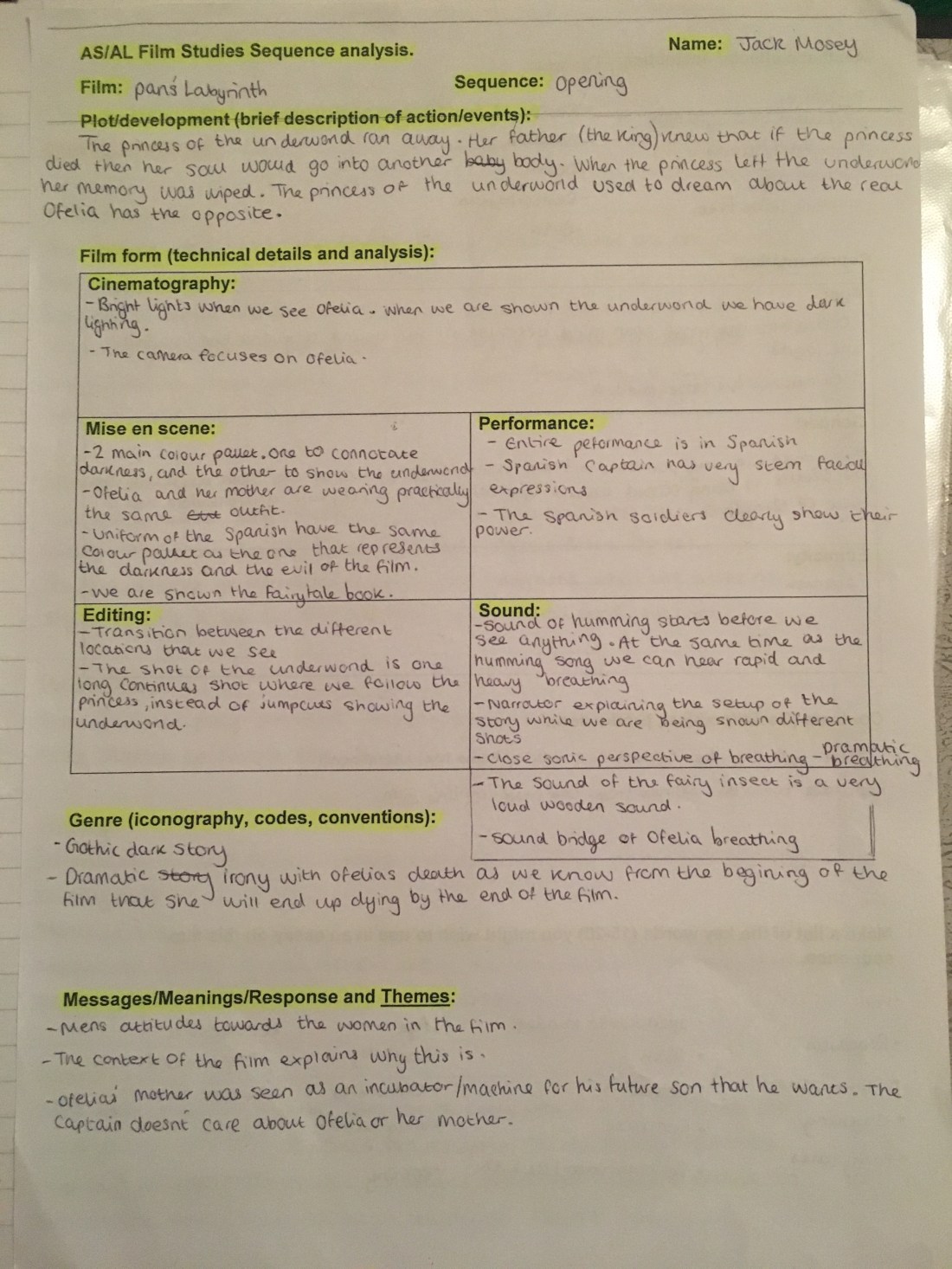
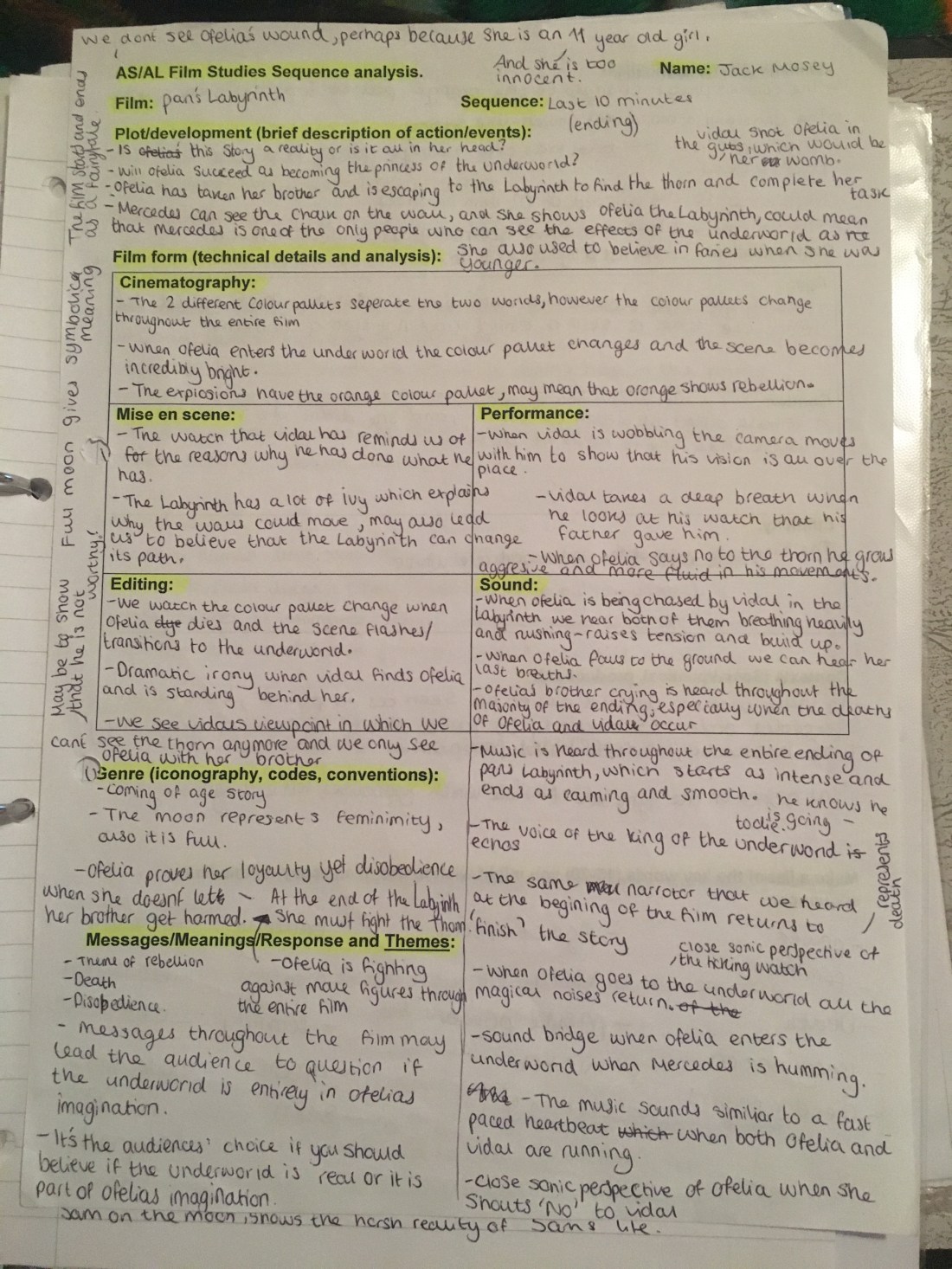
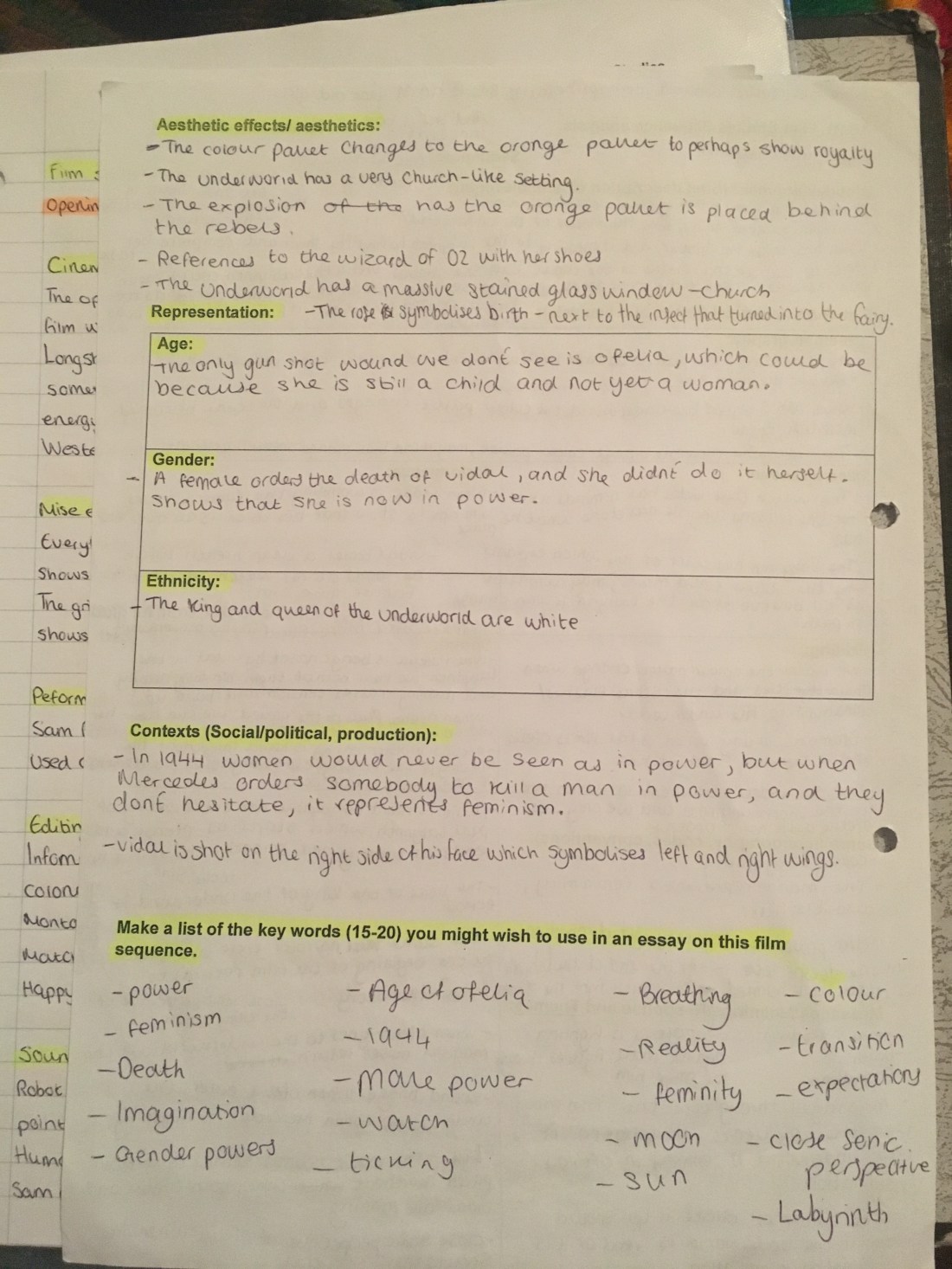
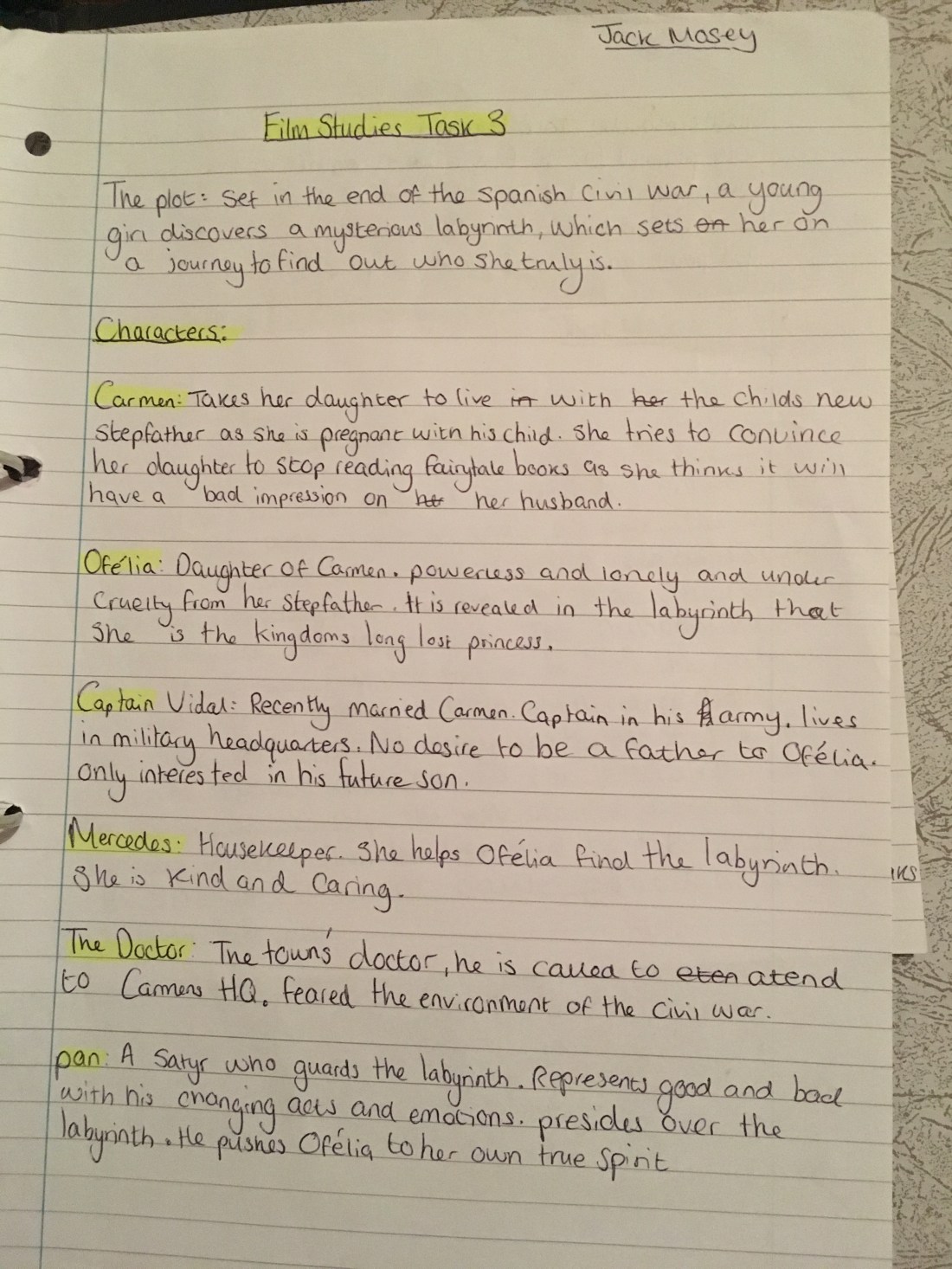
Pan’s Labyrinth Essay

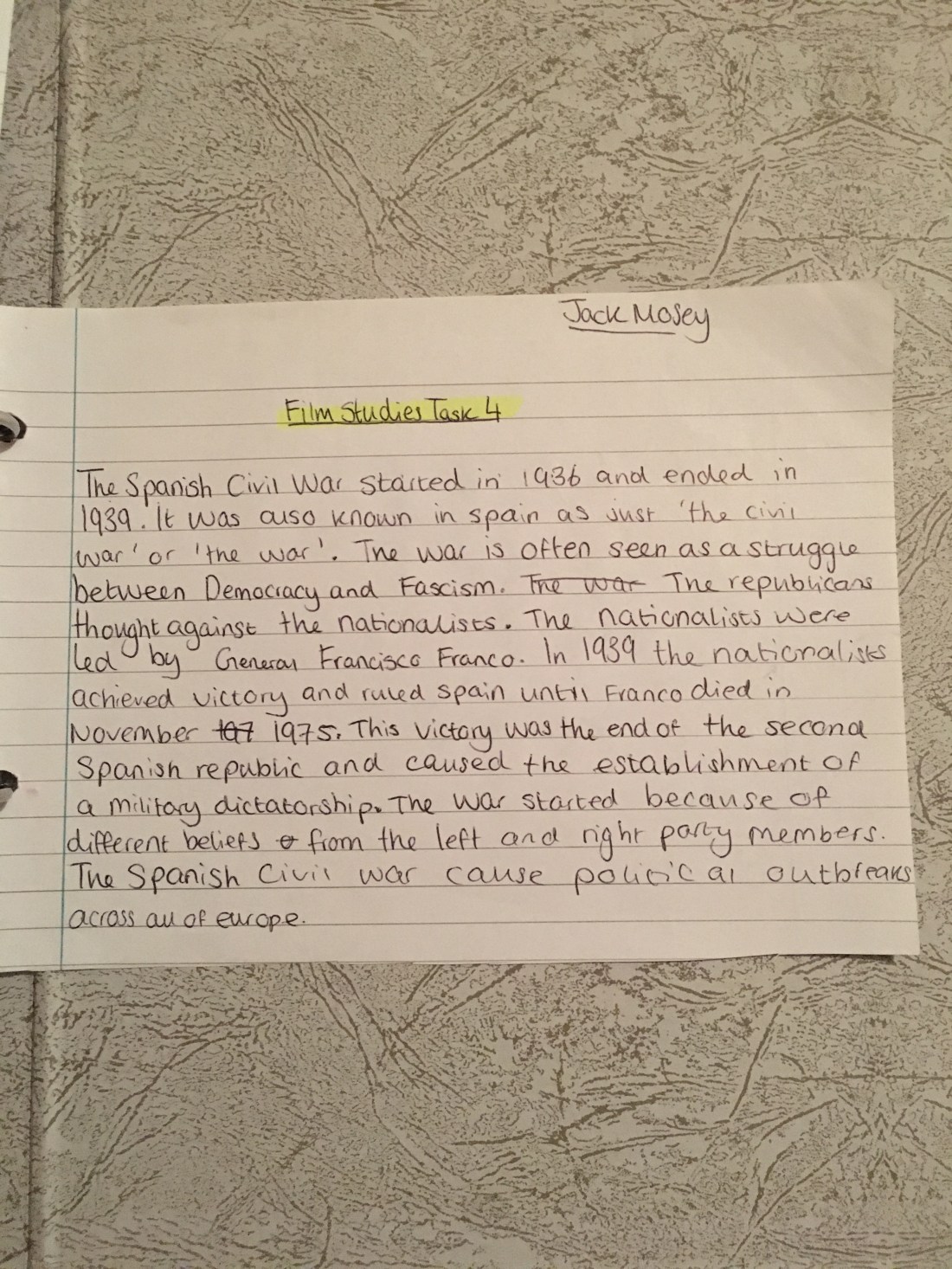
The opening scene to Pan’s Labyrinth, directed by Del Toro, begins with a black screen, showing subtitles that gives context to the film, which is set right after the end of the Spanish Civil War (1944). After this we are a brief description of the princess of the underworld; plus, we are shown the main character (Ofelia).

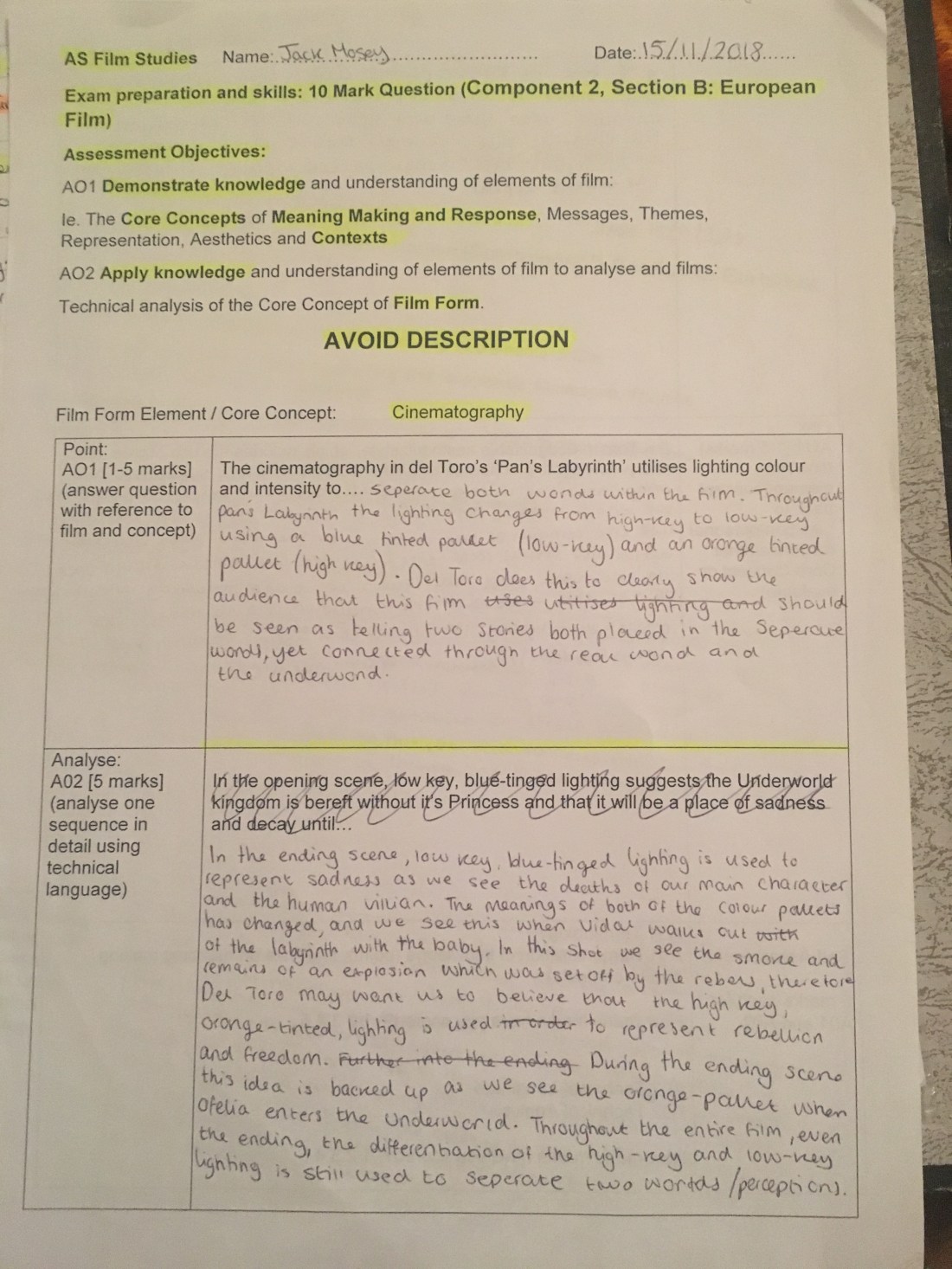
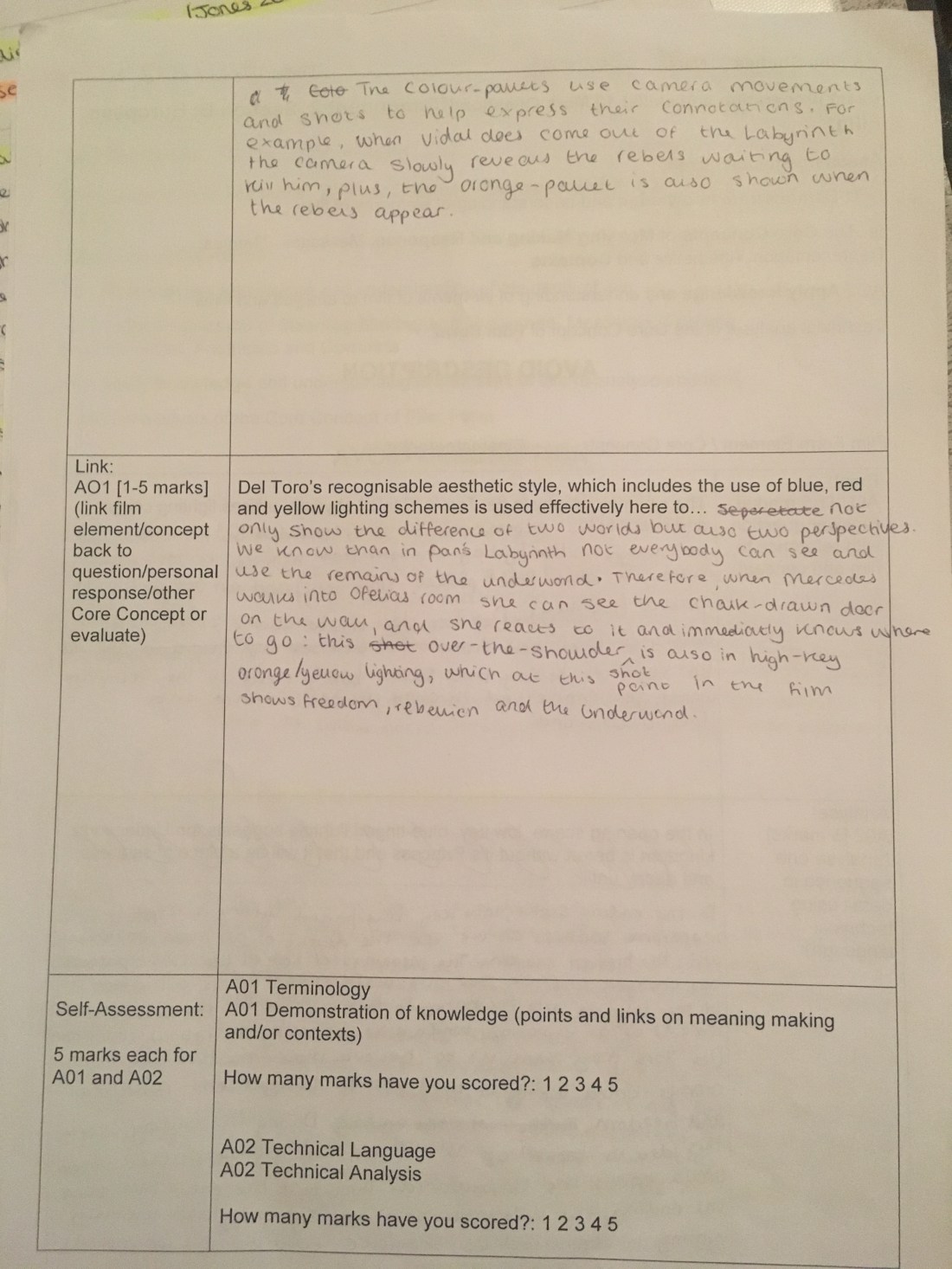
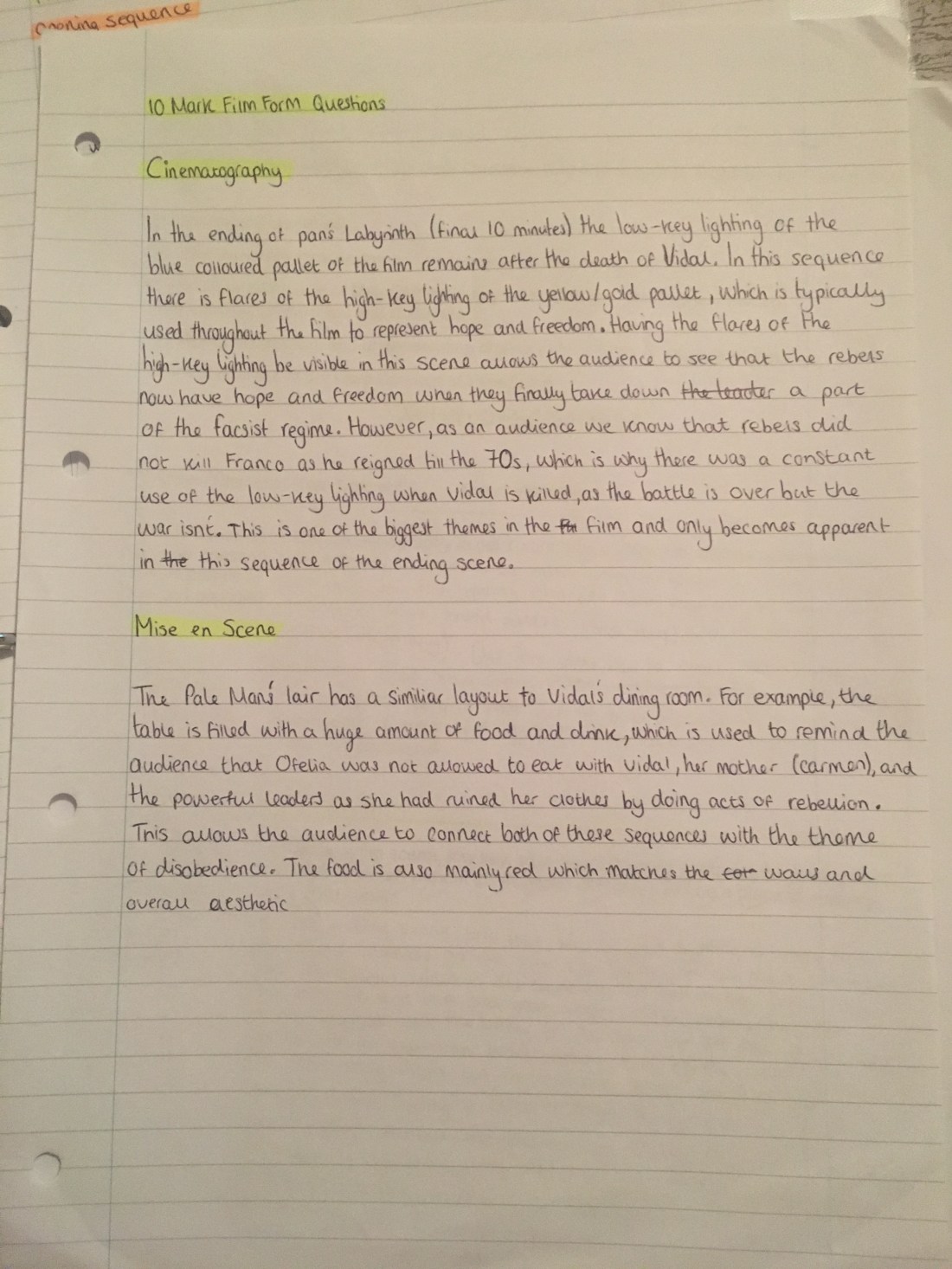
Throughout the opening of the film the five film form elements play key factors into showing what Del Toro wanted the film to foreshadow and represent. The camera focuses on Ofelia/the Underworld Princess during the entire opening, which is done in order to make it clear that she is the key character in the plot of the story. Different lighting is used to separate the way the audience should feel when watching certain scenes, for example, cold lighting colours such as blue are used in order to represent darker and sadder scenes. However, scenes that are focused on Ofelia’s growth throughout the film, such as scenes including the car journey with her mother. The cold lighting may also be to show more horrific scenes, considering the film has a director known for his horror stories.

During the opening mise en scene is used to show representation within the physical objects and clothing. Ofelia and her mother are wearing the same clothes, but in their own individual sizes. This is used to show that Ofelia and Carmen (her mother) may be from a place in conflict, where clothing is limited, which would make sense as the film is set just after the end of the Spanish civil war. The Spanish officers are wearing their uniform, which  has the same colour pallet as the cold colours used to show more horrific and scary scenes typically. Del toro may have done this to show that the officers/ The Spanish Civil war are also horrific or should be seen as a threat to both the audience and Ofelia.

Pan’s Labyrinth tries to show accuracy to the context of the film by having the entirety of the performance in Spanish. This allows the audience to become more engaged with the film and it helps make us understand how the aftermath the war felt for the characters felt, as we see everything from their point of view. Having the film entirely in Spanish also allows the characters within the film to feel realistic, as if this story really happened. Another example of performance is shown with the Spanish Officers, as they are very demanding and use certain wording towards different people. Such as, when the officers refer to Carmen they call her “The captains wife”, which is done to show that during this time women were seen as as objects to men, especially by high authority figures. The performance overall allows the audience to become engulfed within the setting and story of the film.

Del toro uses a certain editing style in the opening of Pan’s Labyrinth to show the different viewpoints of certain characters. For example, when we shown the underworld, it is one long and continuous establishing shot instead of jump cuts showing different areas of the underworld. The long establishing shot is used to show that the camera is from nobody’s viewpoint and to represent how magical the underworld is compared to the real world in 1944.

Sound is one of the key film form features in the opening of Pan’s Labyrinth. It is used in the opening of the film to represent the after life of the princess of the underworld and Ofelia. When Mercedies is humming  we can also hear Ofelia breathing rapidly; during this the camera zooms in on Ofelia, however, the blood running from her nose is going in reverse, which shows that the entire scene is in reverse. But Ofelias breathing and Mercedies humming is still normal with a close sonic perspective. Del toro has done this to show that Ofelia may be dead but the princess of the underworld is still living, and breathing. Ofelias breathing is also used a sound bridge to progress to the next scene of the underworld.

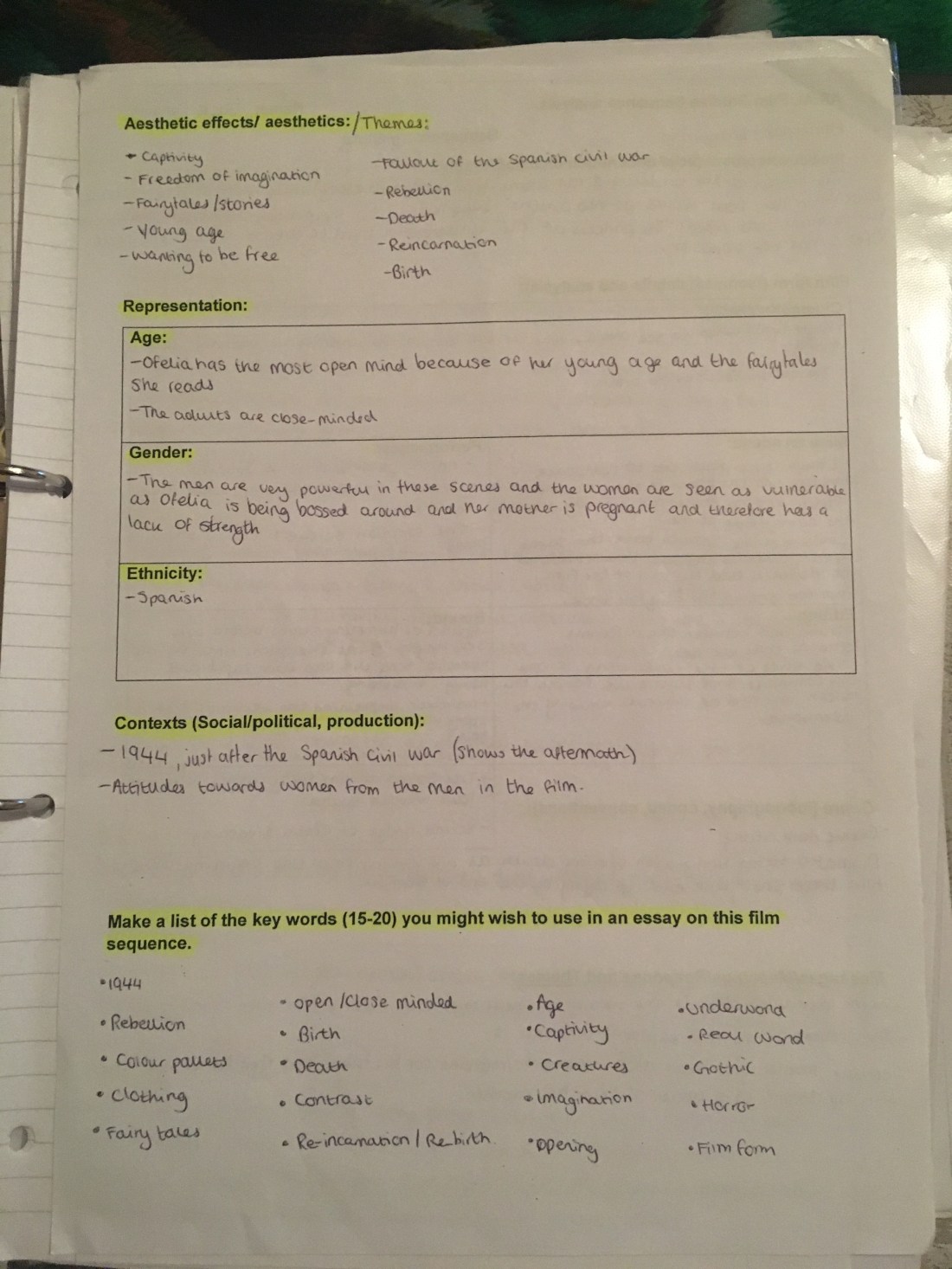
Throughout the opening of Pan’s labyrinth Del toro shows us how Ofelia has had to adapt to becoming mature at a young age. This is shown during the scene where Oflelia and her mother, Carmen, are in the car. Carmen is pregnant and therefore has become vulnerable and sick, which means that Ofelia must take care of her when possible. During this scene, Carmen starts to cough and asks Ofelia if she can stop the car, leading her to knock on the widow to the Officer driving them requesting to stop. However, because Ofelia knew what to do it means that she has had to become more adult-like in order to take as much care of her mother as possible, as she knew what to do immediately.

After the car is stopped the officers refer to Carmen as “the captains wife”, which was included in the performance to represent how women were seen in 1944. This was done in order to show how Carmen was seen as incubator/machine for the captain as he wanted a son who could take his position when he died. Another example of gender stereotypes is shown when Ofelia and Carmen arrive to their new home. When they exit the car Carmen is immediately placed in a wheelchair in order to “take care of the baby” and not Carmen herself. Also when Ofelia puts her hand out to shake with Captain Vidal, he squeezes her hand aggressively and says “wrong hand” in an incredibly blunt way. By having this scene we are clearly shown as an audience what little-to-nothing care the Captain her for Ofelia and Carmen.

One other message/meaning shown within the opening is how children were seen in 1944 with Ofelia and her book of fairy tales. Carmen tells Ofelia that she is too old to read fairy tales, even though we can clearly see that she is still at a young age. Del toro uses this message throughout the entire film to represent how the children are open minded and optimistic, but the adults are the opposite.

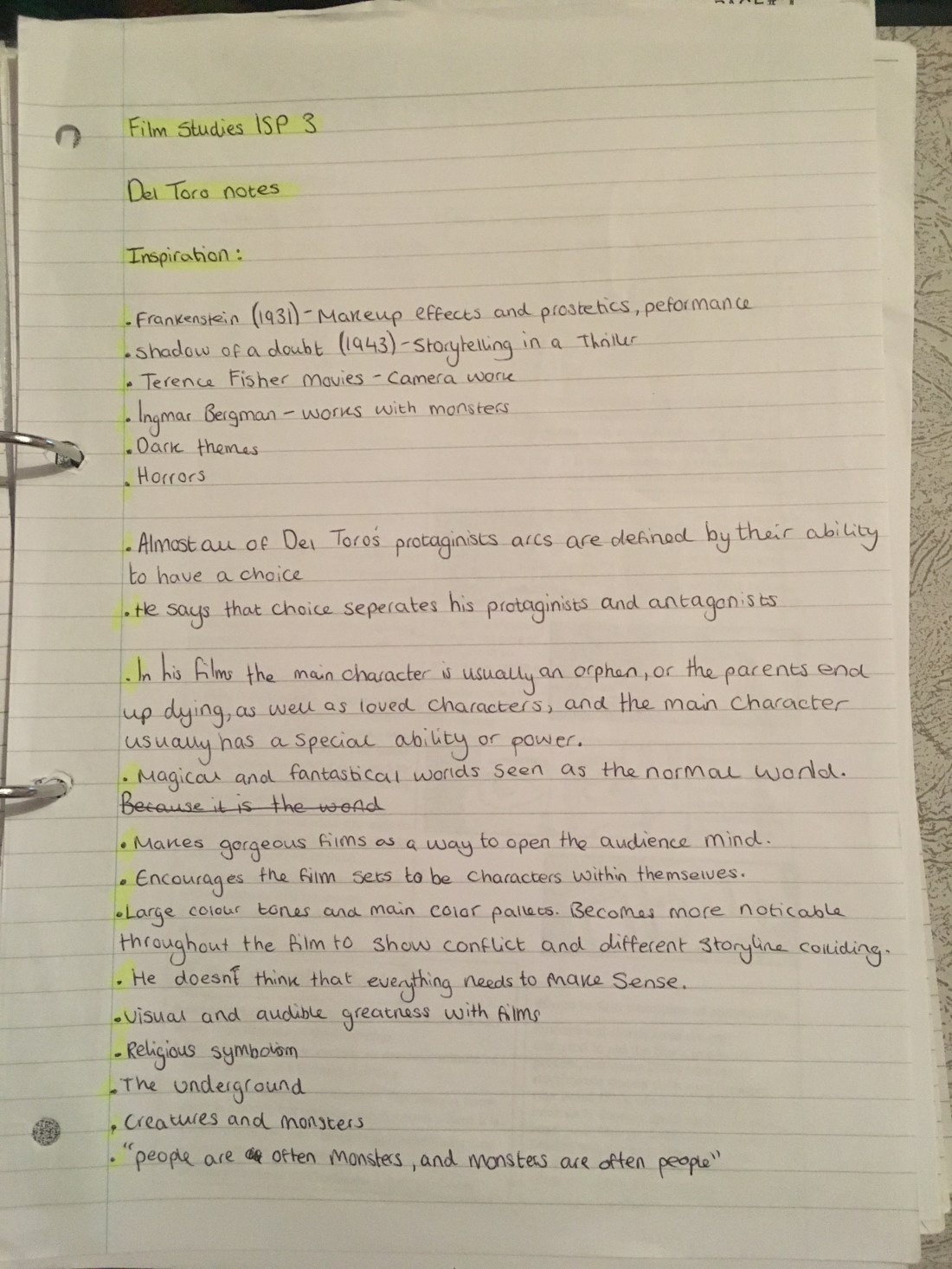
Del Toro is an incredibly unique director, who uses, iconography, codes and conventions to convey messages/meanings/responses to the audience within his work/art and is known for creating magical dark gothic horrors. He is known for creating gorgeous looking films as he has said that he feels as if the set in a film should also have character in order to open the mind of the audience. This is shown in Pan’s Labyrinth when we see the strong colour pallets of cold and warm colours to represent different meanings and add to the characters within the scenes. One of his trends in his work is having a story arc for the protagonist defined by having a choice. He says that he does this in order to separate his protagonists and antagonists. Another trend is that the main character is usually an orphan, or they become one because of the parents death. As well as this, they usually have some kind of special power. In Pan’s Labyrinth we find out that Ofelia is the missing princess of the underworld reincarnated, which gives her special abilities such as being able to see the creatures from the underworld. However, you could say that she has this power because of her optimism, open-mindedness and her young age. Del toro also like to show symbolism within film form, religion, the underground, creatures and monsters. One of the most famous quotes from Del toro is “people are often monsters, and monsters are often people”.

In conclusion, Del Toro conveys messages within the iconography, and his directing overall, by using techniques such as close sonic perspective, sound bridging, themes, context, the film form features, and the genre of dark gothic horrors within Pan’s labyrinth. In the opening five minutes of the film we are given the context of 1944, just after the end of the Spanish civil war, which allows certain plot developments. We are also shows the attitudes that people had towards women, children, and age and how Ofelia stands out from the majority of people in the film. All of the film form features are used in an specific way to represent all of these messages and techniques used by Del Toro to create both a fantasy and realistic universe in Pan’s Labyrinth.

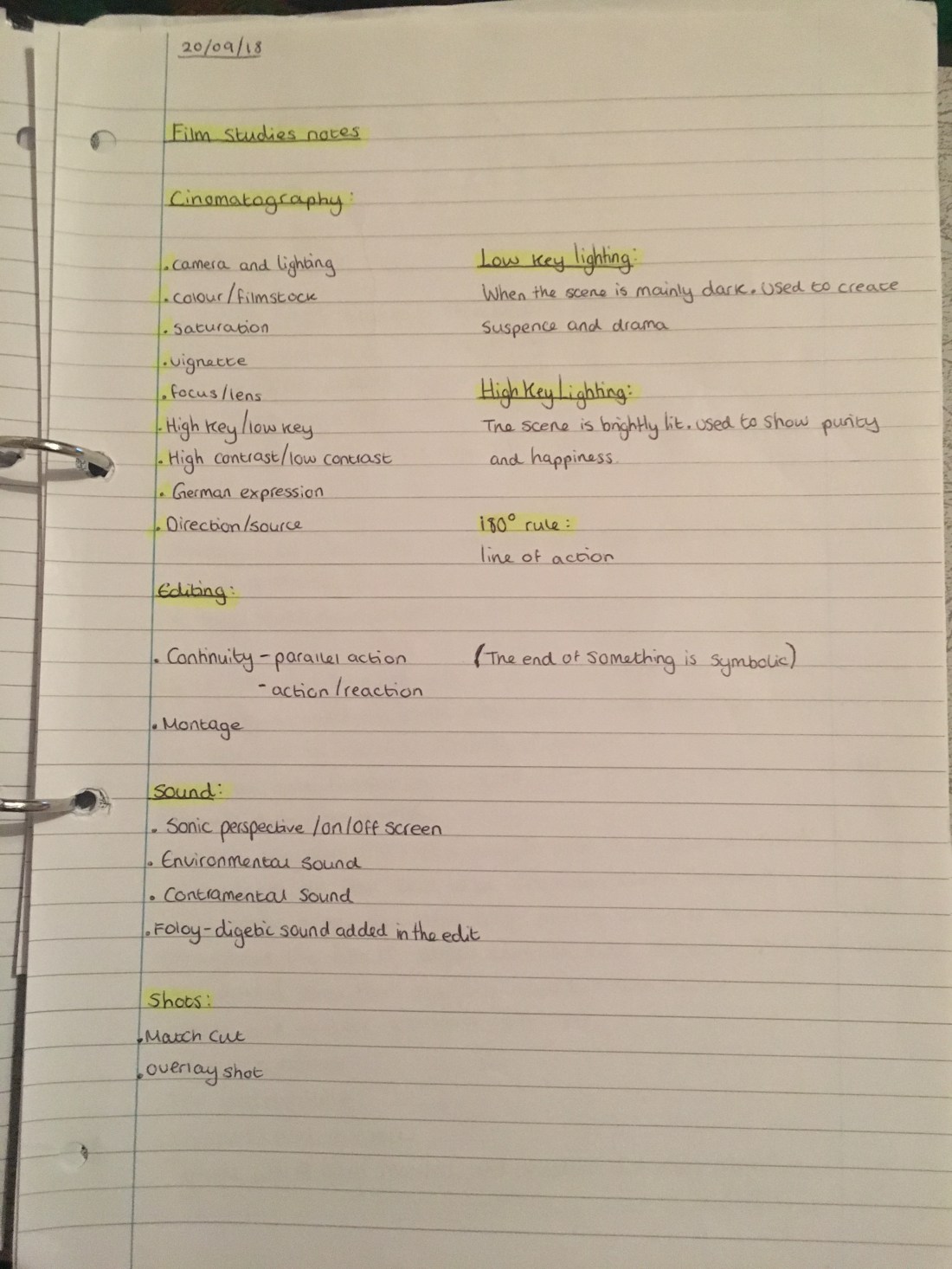
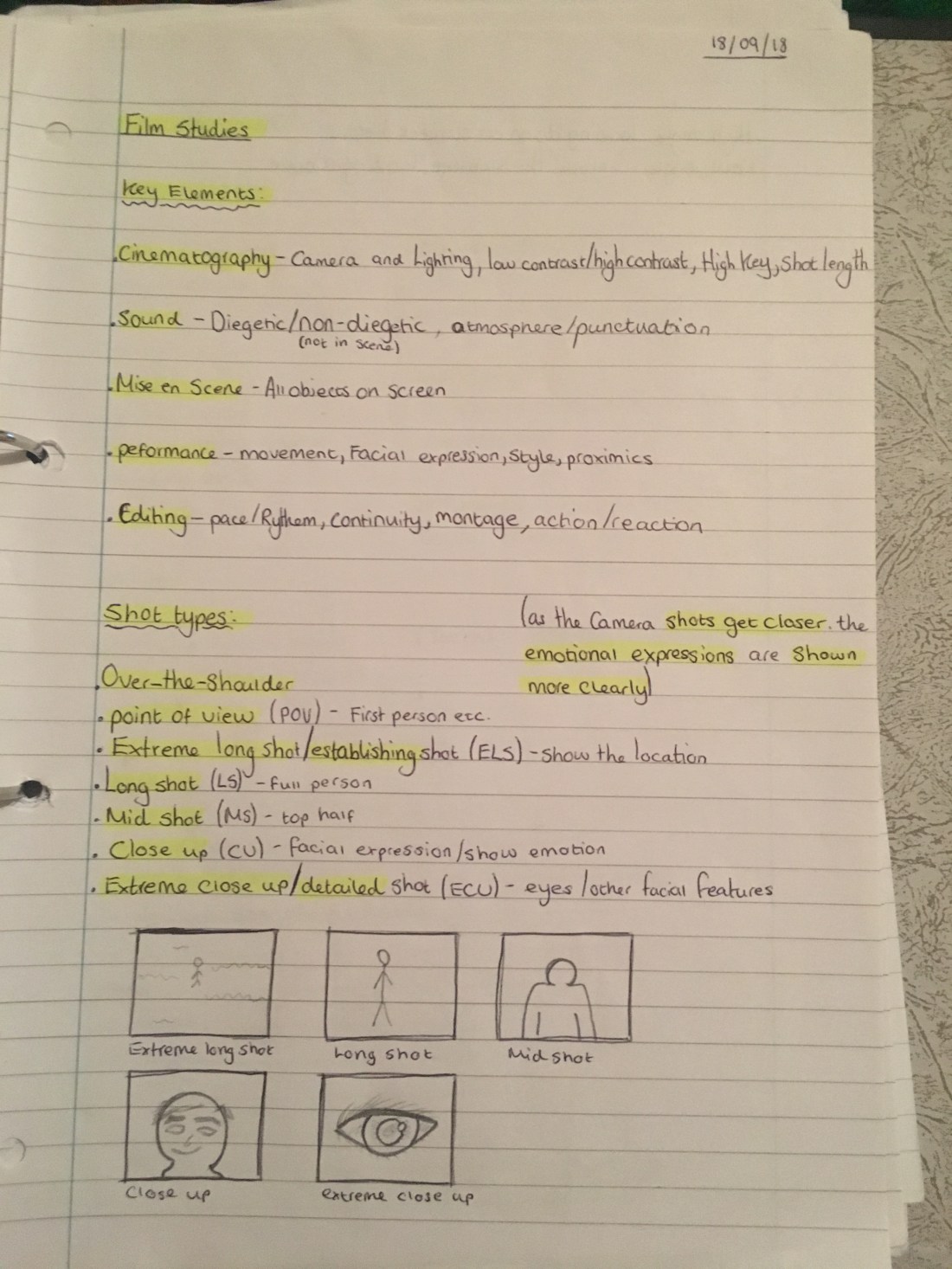
Key Elements Notes

Cinematography: Camera and lighting, low contrast/high contrast, high key, shot length

Sound: Diegetic/non-diegetic, atmosphere/punctuation

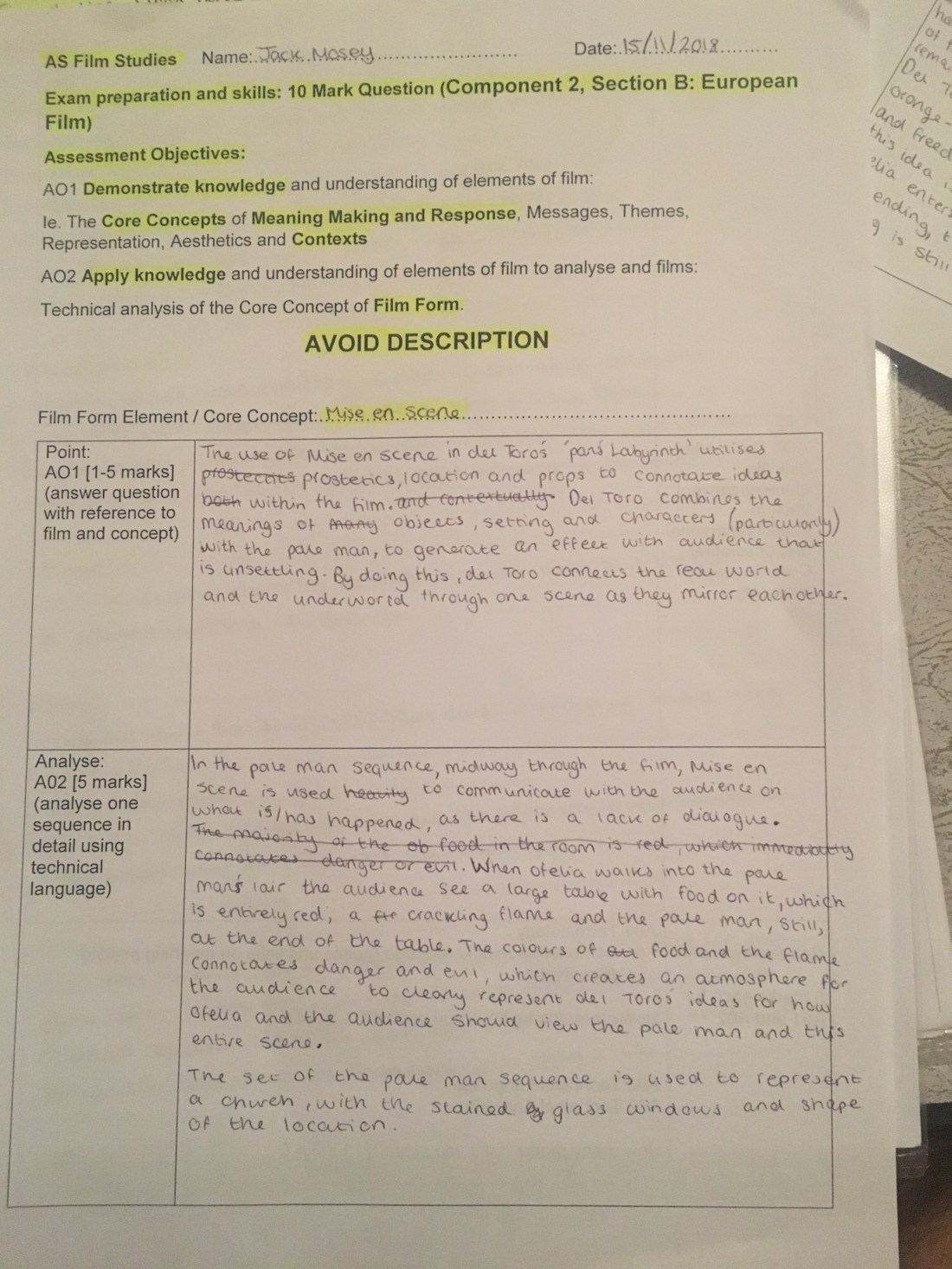
Mise en scene: All objects on screen

Performance: Movement, facial expression, style, proxemics

Editing: Pace/rhythm, continuity, montage, action/reaction

Shot types:

Over the shoulder

Point of view (POV)- first person

Extreme long shot/establishing shot (ELS)- show the location

Long shot (LS)- full person

Mid shot (MS)-top half

Close up (CU)- facial expression/show emotion

Extreme close up/detailed shot (ECU)- eye/other facial features

High angle- Looking down on subject below

Low angle- below the subject, looking above

As the camera shots get closer the emotional expressions are shown more clearly.

2001: A Space OdesseyAssessment

In the opening of the scene we are shown a close up of Frank in the spacecraft, which is done to show detail and emotion in his face. With this shot we can see the panic in his face, which is done to make the audience feel a sense of danger that Frank is in. This close up shot is also a high angle shot, suggesting that the camera angle is coming from the spacecraft, and most likely from Howell, the villain. By doing this, it makes the audience engaged, therefore an active viewer who is feeling emotion from the film. This camera angle is shown at the beginning of the scene in order to create a strong atmosphere and engage the audience.

The lighting in this shot is also a key factor in connotating messages and creating a strong and engaging atmosphere. Most of the lighting in this shot is coming from the console units of the spacecraft. The typical colours in this shot are red, however, they contrast against the deep and black space outside, with the dull spacecrafts flying about. This therefore creates a sense of safety, as the outside gives the audience a sense of danger. Usually, the audience would connotate the mainly red and blinking lights with danger, however, with this context we get the opposite effect. The lights are also a playing factor into showing the emotion of Frank.

During this scene, great sound techniques are used to create an in-depth atmosphere to engage the audience. At first, we only hear the deep and heavy breaths from Frank to express panic with the audience. Throughout the scene there is complete science when we are shown shots of space. Having the silence makes the audience feel unsettled and on edge, as we know that the production of this film is high quality, so having noise at all engages the audience into the scene and makes them feel like they are the ones falling through space. The silence may also represent how Frank has no hope in surviving, as there is nothing out there to save him form what is happening.


I think that the main message conveyed in this scene is that technology I the future will go too far and become too smart for humanity to deal with. This movie is set in 2001, which is about 30+ years after the film was released. At the time, they had no idea how technology would advance (this is the same with the “back to the future” movies). At the time of the production of this film. Society was fascinated buy how technology would advance in the future. This would be because of the year this was released in, 1968, which is just one year before America managed to put men on the moon. This would also mean that the film, and specifically this scene, are a metaphor for the space race during the cold war. The red lights in the scene and the red light that Howell has may represent the Soviet Union, which America was against. But this film suggests that Americans made it to space first, and a long time ago, before they have actually reached the moon. Another reason why we know that this film could have been made as propaganda in the cold war is because there are no women in this scene, or throughout much of the movie. Even the AI Howell is named after a male, but typically technology, like ships and computers, are called females still to this day. Feminism had not advanced very far, as well as other things like gay marriage, and a white person marrying somebody who was black was massively frowned upon, especially by president Nickson. HHoeel